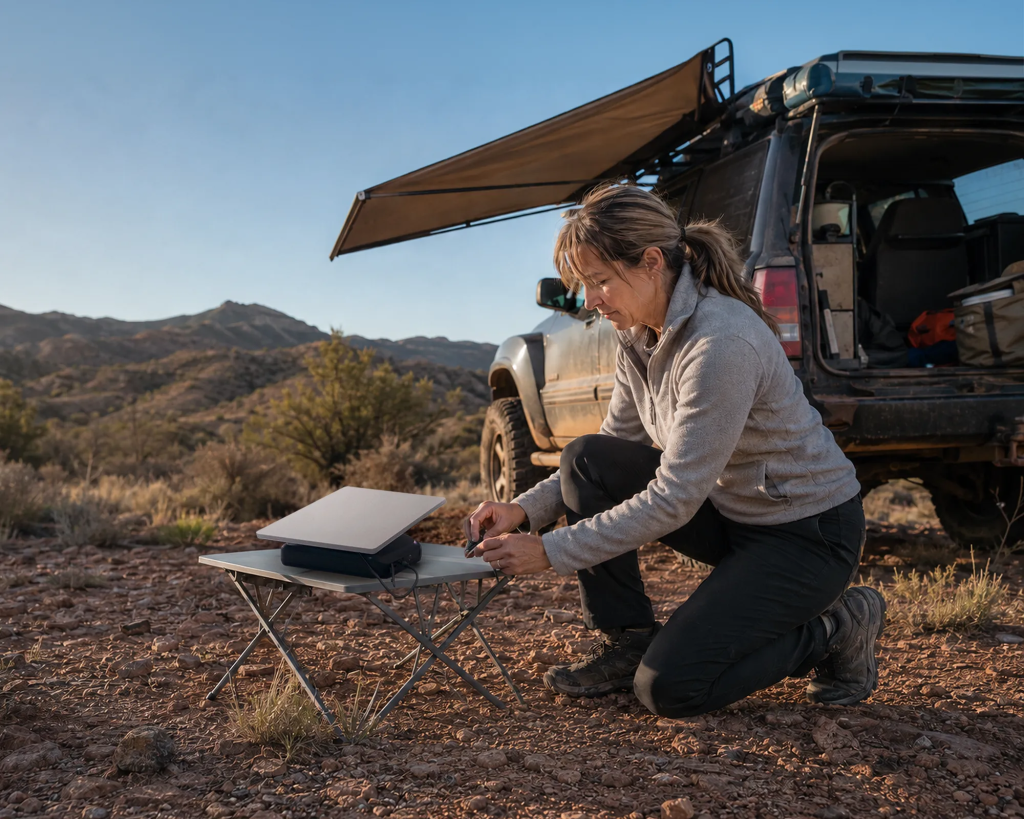


How long will a battery run Starlink Mini?
There is no single answer. Battery runtime depends on usable battery capacity, Starlink Mini’s actual average load, the conversion method, battery condition and the environment. A useful estimate starts with watt-hours, then leaves room for normal losses.
Starlink publishes Mini at an average 25–40W. Use a range rather than assuming a single ideal draw.
The runtime calculation
Battery capacity (Wh) ÷ average load (W) = theoretical hours
A 288Wh battery at a 30W average load gives 288 ÷ 30 = 9.6 hours before real-world losses. It is a planning estimate, not a promise.
| Battery capacity | 25W load | 30W load | 40W load |
|---|---|---|---|
| 100Wh | 4.0 hours | 3.3 hours | 2.5 hours |
| 200Wh | 8.0 hours | 6.7 hours | 5.0 hours |
| 288Wh | 11.5 hours | 9.6 hours | 7.2 hours |
Runtime planning
How do you use your Starlink Mini?
Choose the description closest to a typical session. We’ll translate the technical load into a useful planning estimate.
Planning estimates are indicative only. Actual Starlink Mini power use and runtime vary with network activity, signal conditions, temperature, cable losses and connected devices.
Why actual runtime varies
Conversion losses, cable losses and a battery’s protection settings mean not all rated capacity is delivered to the dish. Starlink’s load also changes with use and conditions. Start with the load you expect, add a margin, and test your own kit before a remote trip.
Is a 20W estimate enough?
Use 20W only as a light-use illustration. A robust plan also checks 25W, 30W and 40W. If you need a full working day of connectivity, the 30W and 40W figures usually provide the safer planning view.
Does Starlink Mini have a battery?
No. It needs an external compatible source. The portable power source must meet Starlink Mini’s requirements; using a battery does not remove the need to check the voltage, connection method and cable compatibility.
Battery runtime on a caravan or vehicle trip
Work out the number of hours you need each day, multiply that by a realistic load, then decide how the battery will recharge. Solar, vehicle charging and mains charging are different replenishment strategies; do not assume a battery will recharge fully from any one of them in a short drive or a cloudy day.
Choosing an all-in-one option
StarGrid combines a 288Wh battery, Starlink Mini power connection, mounting and protective travel storage. View StarGrid and compare its capacity with your own expected average load and trip duration before purchase.
Frequently asked questions
How long does a 288Wh battery last with Starlink Mini?
The simple theoretical range is about 7.2 hours at 40W, 9.6 hours at 30W and 11.5 hours at 25W, before real-world losses.
What affects battery life most?
Average Starlink load, usable capacity, conversion losses, temperature, cable choice and how frequently the battery is recharged.
What should I read next?
Read the Starlink Mini power consumption guide for the underlying watt and watt-hour calculations, then read the 12V setup guide if you are powering Mini from a vehicle or caravan system.